Conferencias y seminarios
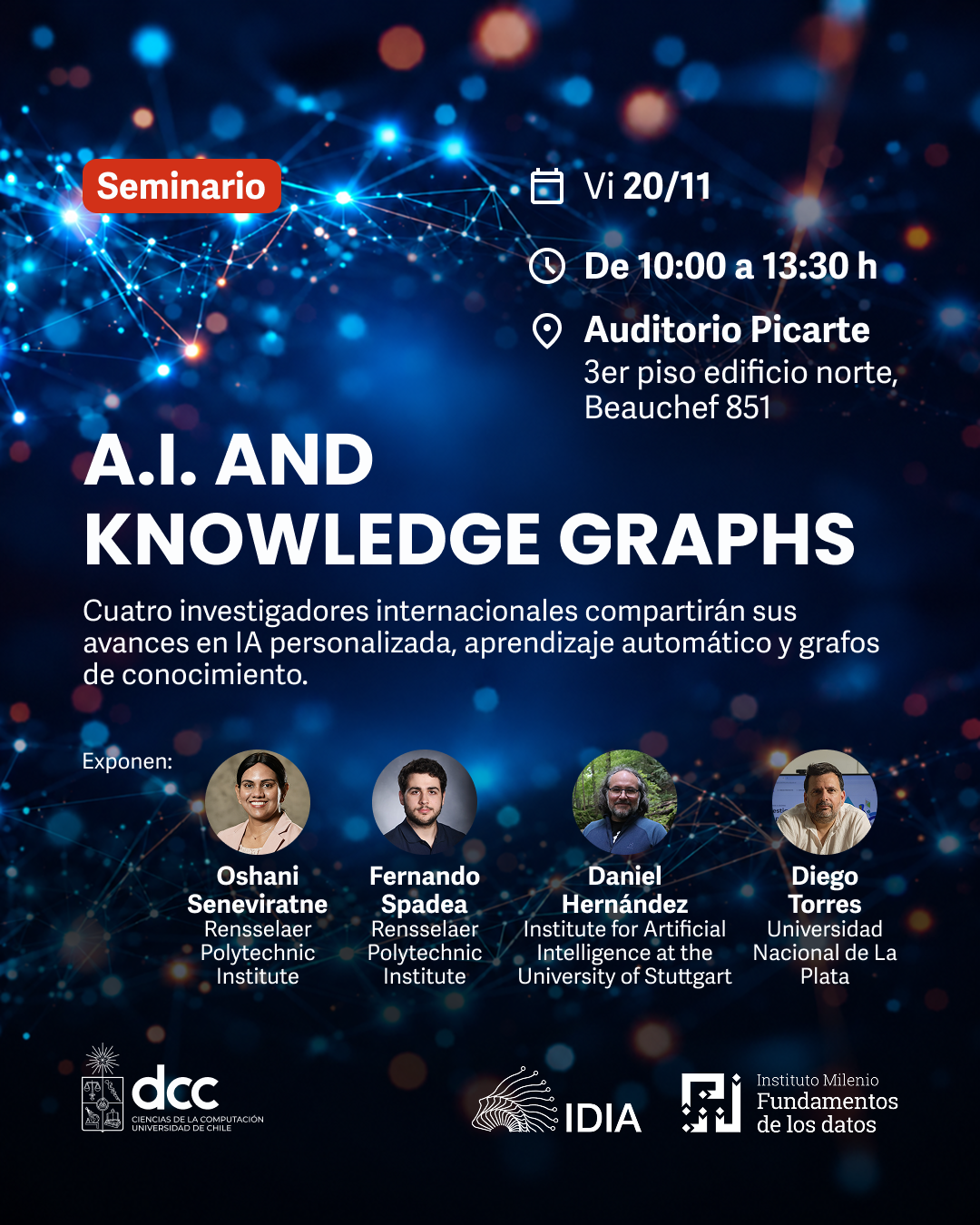
Seminario: A.I. and Knowledge Graphs
Informaciones
- Comunicaciones DCC
- comunicaciones@dcc.uchile.cl
Fecha
Viernes 20 de noviembre de 2026
Hora
10:00
Lugar
Auditorio Picarte DCC - FCFM,
(Beauchef 851, 3er piso Edificio Norte, Santiago)Organiza
*Seminario en inglés
How can knowledge graphs and A.I. be combined to build more intelligent, adaptive, reliable, transparent and trustworthy systems?
In this seminar, four international researchers will present their latest work on evolving knowledge graphs, personalized A.I., machine learning over structured knowledge, and question answering.
Talk 1: "Knowledge Graphs Are Living Systems. Why Do We Build Them Like Finished Products?". Oshani Seneviratne – Rensselaer Polytechnic Institute
In this talk, I’ll challenge the idea of a knowledge graph as a finished artifact: what changes when we treat it as a living system? I’ll present three efforts from the BRAINS group that confront the realities of knowledge graphs in practice: building computable knowledge from unstructured documents, answering multi-hop questions across fragmented graphs, and accommodating new entities as graphs grow. The world won’t stop changing. Why should our knowledge graphs?
Talk 2: "Semantic Web Foundations for Personalized Al: Knowledge Graphs in Decentralized Recommendation". Fernando Spadea – Rensselaer Polytechnic Institute
How can personalized AI systems learn from individual users while keeping their data decentralized and grounding their outputs in relevant, structured knowledge? This talk explores that question through a line of research combining knowledge graphs, lightweight large language models, and federated learning. Beginning with evolving personal knowledge graphs for movie and recipe recommendations, the talk will examine how user interactions can support continual, feedback-driven model adaptation without centralizing the underlying data. It will then extend these ideas to financial recommendations, where personal transaction histories and market information are represented as complementary knowledge graphs. Finally, the talk will consider how parallel and multi-stage retrieval using SPARQL can select compact, relevant subgraphs that fit within limited model contexts. Across these settings, the talk highlights the role of Semantic Web technologies in connecting personal and domain knowledge to support grounded, context-aware recommendations.
Talk 3: "Do Learned Knowledge Graphs Really Capture Knowledge?". Daniel Hernández – University of Stuttgart
Knowledge graph embeddings and knowledge graph foundation models are almost always evaluated on link prediction. That is, building a model to recover a missing fact. Complex query answering builds on it, composing predicted links into logical queries. But do learned knowledge graphs really capture knowledge? By knowledge I mean not only the facts of the ABox, but the TBox of an ontology, its constraints and rules, and beyond. In this talk I will revisit our recent results showing that current evaluations overstate what is learned: complex query answering benchmarks are less complex than they look, and knowledge graph foundation models predict well when the target graph already contains facts about the query's entities and relations, and much less well when it does not, a difference that average scores hide. Large language models learn some knowledge, but a model on its own cannot answer queries that join thousands of existential variables: it has no variable bindings to carry. In contrast, graph-based models score candidate answers to queries of this kind, and they can carry provenance, which allows answers to be explained and, when data is probabilistic, probabilities to be recomputed. The open question is how to learn knowledge, including the TBox, in a form on which such queries can be answered and from which knowledge can be transferred, and how to test that it was learned.
Talk 4: "Question Answering over Dynamic Spatio-Temporal Knowledge Graph: Experiences in the Real Estate Observatory Domain". Diego Torres – LIFIA, Universidad Nacional de La Plata
In recent years, a method of data mining and service analysis called Knowledge Base Question Answering (KBQA) has emerged. Given a natural-language question, the KBQA system aims to respond with the correct entities based on a given knowledge base (KB). A specialization within this field is Knowledge Graph Question Answering (KGQA), which uses a knowledge graph (KG) as its knowledge source and leverages triples stored in the KG to answer natural-language questions. This talk will describe findings and challenges in combining KGQA with large language models (LLMs) and developing benchmarking methods to analyze these approaches' capabilities.